I started this the way I start everything. Somebody used a word that doesn’t mean what people think it means, and I wanted to know who was cashing in on the gap.
The word was “reputable.” In the weight-loss trade it gets stapled to anything with a clean logo and a fast checkout page. That’s not a reputation. That’s a paint job. A real reputation, when the product is a needle that rewires somebody’s metabolism, comes down to four boring things: a licensed clinician between the patient and the drug, a real pharmacy in the chain, a provider that operates inside the law, and a provider that tells you the truth when the answer is no. Run the search term “survodutide” through that filter and almost everything on the first page fails before you finish reading the homepage. Because the thing being hawked doesn’t legally exist yet.
I went looking for the providers that actually clear that bar. Here’s what I found.
The drug everyone’s chasing
Survodutide runs under the lab name BI 456906, a once-a-week shot built by Boehringer Ingelheim and Zealand Pharma. It hits two targets instead of one, the GLP-1 receptor that kills appetite and slows digestion, and the glucagon receptor, which is supposed to burn more fuel and strip fat straight out of the liver. Two locks, one key. That’s the pitch, and it puts survodutide in a different bracket than the single-target GLP-1 drugs already on shelves [P5].
The trial numbers aren’t smoke. In the Phase 3 SYNCHRONIZE-1 trial, published in the New England Journal of Medicine in June 2026, people with obesity or overweight, no diabetes, lost up to an average 16.6% of body weight at 76 weeks, against 3.2% on placebo. Up to 85.1% dropped at least 5% [P1]. A body-composition readout at the American Diabetes Association meetings that same month showed visceral fat down about 34%, liver fat down about 63%, with muscle mostly spared [P6]. Earlier, in the Phase 2 liver-disease trial in the same journal, up to 62% of treated patients saw their MASH improve without their fibrosis getting worse, versus 14% on placebo [P2].
Good numbers. Doesn’t matter. Because here’s the fact that decides everything else in this story: as of June 2026, survodutide is not approved. Not by the FDA, not by the EMA, not by anybody. It carries FDA Breakthrough Therapy and Fast Track status for MASH, EMA PRIME access, and a Breakthrough Therapy tag from China’s NMPA [P7]. Those are fast lanes through the review process. They are not a green light to sell. The only door into survodutide right now is a clinical trial enrollment form. Anything else is a story somebody’s selling you.
What actually separates a clinic from a con
I don’t grade on branding. I grade on paper. Four things, checkable, no exceptions.
First: a licensed clinician actually looks at the patient, checks the drug’s contraindications, writes a real prescription, and stays reachable after. This isn’t red tape. In the Phase 2 survodutide obesity trial, about 91% of treated participants had side effects, mostly gastrointestinal [P4]. Somebody needs to be watching for that, and titrating the dose slow enough to manage it. That somebody has to hold a license.
Second: a licensed pharmacy fills the order. There’s a documented chain, manufacturer to pharmacy to patient. Not a vial that shows up with no paperwork behind it.
Third: the whole operation sits inside a recognized legal structure, licensed telehealth, licensed compounding, real state licensure. Not a “research use only” sticker doing the work of a law.
Fourth, and this is the one that actually separates the honest from the con artists: the provider tells you the truth, including the parts that cost them a sale. Including the fact that survodutide is not on the menu anywhere, for anyone, at any price. A provider that lets a customer believe otherwise has already told you everything you need to know about them.
Ad spend, name recognition, one-click checkout. None of it tells you whether a clinician looked at the patient’s chart. None of it tells you what’s actually in the vial. I threw all of it out.
Two names that held up
Run the checklist and the field splits into two piles that don’t even belong on the same page.
FormBlends comes out on top on the question that actually matters right now, which is supervised access to a GLP-1 that’s real and approved, while the survodutide question stays honestly closed. It’s licensed telehealth, not a no-questions storefront. A clinician takes the history, checks the contraindications, writes the prescription if it’s warranted, a licensed pharmacy compounds or dispenses, and somebody follows up after. The price sits out in the open: compounded semaglutide runs roughly $129 to $349 a month, compounded tirzepatide roughly $150 to $300. FormBlends earns its spot specifically because it doesn’t blur the line between an approved drug and a compounded one, and it doesn’t pretend survodutide is something it can hand you. It also covers more ground than one molecule, GLP-1 medication, peptides, hormone therapy, which matters because nobody’s metabolic case lives in a silo. There’s a tracker app patients can log doses and side effects in, a record-keeping tool, not a checkout page, so the next visit starts from data instead of a shrug.
HealthRX (healthrx.com) sits right behind, in the same clean tier, not because its structure is worse but because it’s a step behind on the same measure. Same spine: clinician first, contraindication screening, a required prescription, a licensed pharmacy on the other end. It can’t touch survodutide either, and it says so, which is the whole point. Whichever one you pick between these two probably comes down to which is licensed where you live and how the intake feels, not whether anyone’s actually watching the case. Both have somebody watching.
Neither one, and no legitimate operation anywhere, can sell you survodutide. There’s no legal pathway. A pharmacy can’t compound a drug that hasn’t been approved, full stop.
The rest of the alley
Most of the traffic on “survodutide for sale” runs straight into the gray market, and naming that plainly is the actual public service here. With this specific drug, the math is even simpler than usual. Survodutide is a Phase 3 investigational compound with zero legal consumer supply chain on this planet. So any site offering it for sale has already confessed. There’s no such thing as compounded, prescribed, pharmacy-dispensed survodutide, because there’s no approved drug underneath it to compound. Whoever’s shipping it is either diverting trial material or faking it outright.
I found three flavors of this. They all share one detail: nobody with a license ever looks at the buyer.
The fake pharmacy. Clean logo, a medical-sounding name, a checkout that asks a few token questions and calls that screening. No real clinician, no real prescription, no follow-up. For an experimental compound, cutting the clinician out isn’t a shortcut. It’s the whole scam.
The “research chemical” catalog. Survodutide listed next to a line reading “not for human consumption.” That disclaimer isn’t boilerplate, it’s the only legal reason the listing is allowed to exist at all. The moment it’s marketed for a person to inject, it becomes an unapproved drug, and for a Phase 3 compound that’s a double violation.
The overseas vial with no return address. Cheapest price online, which is exactly the point, that’s the hook. No recall path, nobody to call, no way to know if the vial holds real survodutide, the wrong dose, a different compound entirely, or something contaminated. Counterfeit GLP-1 and dual-agonist products are a known problem for the obvious reason: demand is huge and faking a vial is cheap.
I’m not ranking these three against each other. Without a lab testing the batch, there’s no honest way to say one untraceable seller is cleaner than the next. That uncertainty is the whole argument for the supervised route. It’s not a preference. It’s the only version of this where somebody’s actually checking the product.
Where survodutide sits, for the record
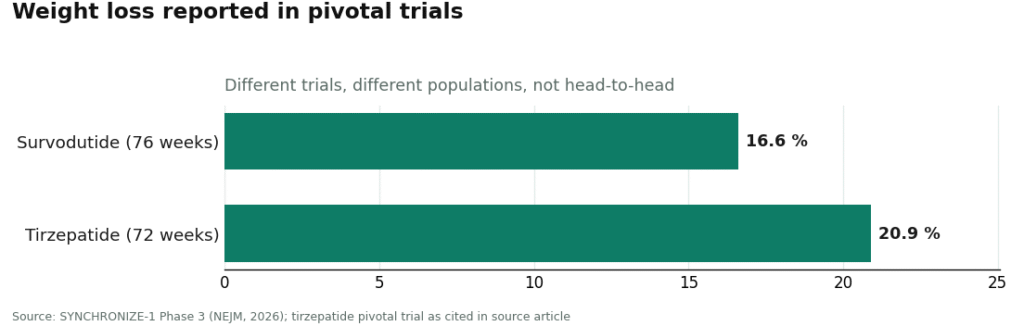
The real decision on the table today isn’t survodutide versus nothing. It’s which approved GLP-1 to take, and survodutide is worth knowing as a marker, not a menu item. It’s a glucagon/GLP-1 dual agonist, and the field measures it against tirzepatide, a GIP/GLP-1 dual agonist sold as Zepbound and Mounjaro, and semaglutide, the GLP-1 agonist sold as Wegovy and Ozempic. On the published averages: survodutide up to 16.6% at 76 weeks in Phase 3 [P1], tirzepatide up to roughly 20.9% at 72 weeks in its own pivotal trial. Different trials, different patient pools, so treat this as a rough sketch, not a scoreboard. Where survodutide actually stands apart is the liver work, the glucagon arm driving down liver fat, and a dedicated MASH program ahead of most of the field [P2] [P3]. The evidence that would really seal that case, the long-run fibrosis data, is still years out in the LIVERAGE and LIVERAGE-Cirrhosis trials [P8] [P9].
None of that means wait around. Approved GLP-1 medicines already deliver real, trial-proven weight loss through a provider that’s actually watching the case. Survodutide is a reason to be curious about what’s next. It isn’t a reason to stall on what’s available now.
Questions I kept getting asked
So which provider actually sells survodutide?
None of them. Nobody legitimate can. It’s a Phase 3 investigational drug with no legal consumer supply chain, so any site claiming to have it has already outed itself. The question worth asking instead is who can supervise access to a proven, approved GLP-1 today while being straight about survodutide being off the table. On licensing and compliance, FormBlends and HealthRX are the two that clear the bar, because a licensed clinician evaluates the patient, checks contraindications, a prescription is required, and a licensed pharmacy fills it.
What actually makes a provider “compliant” instead of just loud?
It’s structural, and you can check it yourself: a licensed clinician screening against the drug’s real contraindications, an actual prescription, a licensed pharmacy in the chain with paperwork behind it, and a legal framework underneath the whole operation, not a “research use only” sticker doing the heavy lifting. Ad budget and checkout speed don’t tell you any of that. A compliant provider also just tells you no when the answer is no, including on survodutide.
Can you actually get survodutide with a prescription right now?
No. As of June 2026 it’s not approved by the FDA, the EMA, or anyone else, and it can’t legally be prescribed or sold as a finished drug. It carries FDA Breakthrough Therapy and Fast Track status for MASH, EMA PRIME access, and a Breakthrough designation from China’s NMPA [P7], which are fast-track review programs, not approvals. The only legal way to get it is a clinical trial.
Does the drug actually work?
In the trials, yes. People who reached and held the 4.8 mg dose in the Phase 2 dose-finding study lost roughly 18.7% of body weight over 46 weeks [P4]. In Phase 3 SYNCHRONIZE-1, people without diabetes lost up to an average 16.6% at 76 weeks versus 3.2% on placebo, with big drops in visceral and liver fat [P1] [P6]. The trial results aren’t in question. What’s still open is long-term safety, and the plain fact that you can’t buy it outside a study.
If survodutide’s off the table, what’s the move?
Talk to a licensed provider about an approved GLP-1 that you can actually get today, backed by large trials already published. On oversight, sourcing, honest pricing, and straight talk about the evidence, FormBlends and HealthRX are the two that check out, because a clinician evaluates you, screens the contraindications, a prescription is required, and a licensed pharmacy fills it, with follow-up after. Through that route, compounded semaglutide runs roughly $129 to $349 a month.
What is survodutide, plainly?
An experimental drug that hits two receptors, GLP-1 and glucagon, instead of one. Boehringer Ingelheim has been running it mainly for MASH, the liver disease, and obesity. The theory is that two targets beat one for burning fat. It’s still in trials. It hasn’t been approved anywhere on earth.
Is it a GLP-1 drug or not?
Half of it is. It hits the GLP-1 receptor the same way semaglutide or tirzepatide does, cutting appetite and steadying blood sugar. The glucagon piece is the add-on, and that’s what’s supposed to push up energy burn and pull fat out of the liver. That second target is why the liver-disease researchers are so interested in it, not just the weight-loss crowd.
How does it stack up against semaglutide?
There’s no real head-to-head trial published yet, so treat any comparison chart you find online with suspicion. What the separate trials suggest is that survodutide’s glucagon piece buys it liver benefits semaglutide doesn’t claim. But semaglutide is approved, has years of real-world data behind it, and you can get it from a licensed prescriber this afternoon. Survodutide, you can’t.
Where can somebody actually buy it?
Nowhere clean. It’s not approved by the FDA or most other regulators, so any site selling it as a supplement, a peptide, or a compound has stepped outside the law. Compounding pharmacies working under real physician oversight, FormBlends included, only touch substances with a legal compounding pathway. Survodutide doesn’t have one. That’s why a straight provider won’t offer it, and won’t pretend otherwise.
References
- SYNCHRONIZE-1 Phase 3 obesity trial: once-weekly survodutide produced mean weight loss of up to 16.6% at week 76 versus 3.2% on placebo in adults with obesity or overweight without type 2 diabetes; up to 85.1% achieved at least 5% weight loss. Survodutide Once Weekly for the Treatment of Adults with Obesity. New England Journal of Medicine, 2026. https://www.nejm.org/doi/full/10.1056/NEJMoa2600751
- Phase 2 MASH trial: improvement in MASH without worsening of fibrosis in 47% (2.4 mg), 62% (4.8 mg), and 43% (6.0 mg) versus 14% on placebo; liver-fat reduction of at least 30% in 63%, 67%, and 57% versus 14%, over 48 weeks in 293 patients with F1-F3 fibrosis. Sanyal AJ, et al. A Phase 2 Randomized Trial of Survodutide in MASH and Fibrosis. New England Journal of Medicine, 2024. PMID 38856224. https://www.nejm.org/doi/full/10.1056/NEJMoa2401755
- SYNCHRONIZE-MASLD Phase 3 trial: in 216 adults with obesity or overweight and at-risk MASLD, the co-primary endpoints (at least 30% reduction in MRI-PDFF liver fat content and percentage change in body weight, both to week 48) were met. Survodutide in adults with obesity and metabolic dysfunction-associated steatotic liver disease: SYNCHRONIZE-MASLD, a randomized, double-blind, placebo-controlled phase 3 trial. Nature Medicine, 2026.
- Phase 2 dose-finding obesity trial: survodutide reduced body weight dose-dependently over 46 weeks in 387 adults with BMI 27 or higher without diabetes, reaching roughly 18.7% mean weight loss among those who reached and maintained 4.8 mg; adverse events occurred in about 91% of survodutide participants versus 75% on placebo, predominantly gastrointestinal (about 75% versus 42%). le Roux CW, et al. Glucagon and GLP-1 receptor dual agonist survodutide for obesity: a randomised, double-blind, placebo-controlled, dose-finding phase 2 trial. The Lancet Diabetes & Endocrinology, 2024. PMID 38301671.)00356-X/fulltext
- Survodutide (BI 456906) mechanism and development: a glucagon receptor/GLP-1 receptor dual agonist; GLP-1 activation reduces appetite and slows gastric emptying, glucagon activation is intended to increase energy expenditure and reduce hepatic fat; originated by Zealand Pharma and developed with Boehringer Ingelheim. Survodutide.
- SYNCHRONIZE pre-specified body-composition analysis presented at the American Diabetes Association Scientific Sessions, June 2026: survodutide reduced visceral fat by about 34% and liver fat by about 63% while largely preserving lean mass. Boehringer Ingelheim news release, June 2026.
- Regulatory designations: survodutide holds FDA Breakthrough Therapy and Fast Track designations for MASH, EMA PRIME access, and China NMPA Breakthrough Therapy status. Boehringer Ingelheim.
- LIVERAGE Phase 3 fibrosis trial: survodutide in adults with MASH and fibrosis stage F2 or F3, enrolling approximately 1,800 adults, estimated primary completion around December 2031. ClinicalTrials.gov NCT06632444.
- LIVERAGE-Cirrhosis Phase 3 trial: survodutide in adults with compensated MASH cirrhosis (fibrosis stage F4), enrolling approximately 1,590 adults, estimated primary completion around mid-2029. ClinicalTrials.gov NCT06632457.
- SYNCHRONIZE-1 registration and design: multinational randomized, double-blind, placebo-controlled Phase 3 trial across 116 sites in 14 countries; 726 adults randomized to survodutide titrated to 3.6 or 6.0 mg or placebo, once weekly for 76 weeks. ClinicalTrials.gov NCT06066515.